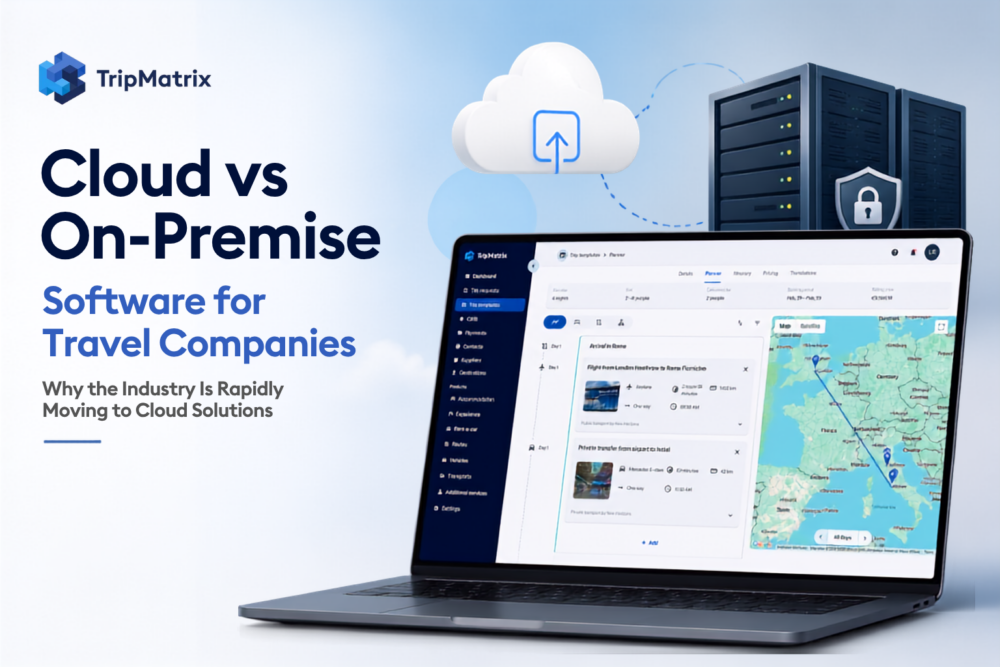
Cloud vs On-Premise Software for Travel Companies: Why the Industry Is Rapidly Moving to Cloud Solutions
Digital Transformation Challenges
The travel industry is undergoing rapid digital transformation, but several structural and technological barriers continue to slow progress. Key challenges such as fragmented data, outdated legacy systems and inconsistent technology standards make it difficult for organizations to deliver seamless and personalized traveler experiences.
Legacy systems:
Many travel organizations still depend on outdated legacy systems that are inflexible, expensive to maintain and not designed for today’s digital environment. These systems struggle to integrate with modern technologies or enable the smooth, real-time services that travelers increasingly demand.
Data fragmentation:
Fragmented data continues to be a major issue in the travel industry, with information stored across numerous stakeholders and frequently in incompatible formats. This makes it challenging to build a complete view of the customer and provide personalized, seamless experiences across different interactions.
New standards:
The absence of unified technological standards across the travel sector slows digital progress. Differences in systems, inconsistent framework adoption and incompatible APIs create barriers to effective collaboration among suppliers, intermediaries and technology partners.
One of the key ways travel companies are addressing these digital transformation challenges is through their choice of technology infrastructure, particularly when deciding between cloud-based and on-premise software solutions. This decision plays a crucial role in improving operational efficiency, enabling scalability and supporting faster adaptation to changing market demands.
By closely monitoring industry trends and evolving technological requirements, TripMatrix recognizes a clear shift within the travel sector toward cloud-based solutions, as they provide greater flexibility and help travel companies accelerate their digital transformation.
What Is Cloud Software for Travel Companies?
Cloud software allows business applications to be accessed via the internet without requiring local installation or infrastructure maintenance. Systems are hosted on secure, highly available servers, while users access the platform through web browsers or applications.
For travel companies, this means seamless access to booking systems, CRM tools, sales analytics, and partner management platforms, without location or device limitations.
Cloud technology is particularly valuable in the travel industry due to its seasonal and dynamic nature. During peak seasons, companies often experience a significant increase in bookings and operational demands. Cloud platforms enable instant resource scaling, ensuring system stability without requiring additional hardware investments.
Additionally, cloud solutions are continuously updated. Travel companies gain access to new features, security enhancements, and integrations without operational disruptions or complex implementation projects.
On-Premise Software: A Traditional Approach with Full Control
On-premise solutions are installed on local servers within an organization, providing full control over data, infrastructure, and security policies. This model is still used by travel companies with highly specific compliance requirements or complex internal workflows.
However, maintaining on-premise systems requires substantial technical and financial resources. Organizations must manage server infrastructure, perform regular system upgrades, and maintain internal IT teams responsible for security and performance. Implementing new features or integrations often takes longer, which can slow down digital transformation efforts.
In an industry driven by global collaboration and multi-location operations, locally hosted systems can also limit data accessibility and complicate integration with external platforms.
Cloud vs On-Premise: Key Differences for Travel Companies
|
Feature |
Cloud-Based Solutions |
On-Premise Solutions |
|
Initial Costs |
Lower and predictable |
High upfront investment |
|
Scalability |
Instantly adjustable |
Infrastructure dependent |
|
System Maintenance |
Managed by the service provider |
Requires internal IT resources |
|
Implementation Speed |
Fast and straightforward |
Typically longer deployment cycles |
|
Data Accessibility |
Global, real-time access |
Usually limited to internal networks |
|
Partner Integrations |
Flexible and simplified |
Often complex and resource-intensive |
Why Cloud Is Becoming the Travel Technology Standard
The modern travel ecosystem relies on seamless connectivity between multiple systems, including booking engines, GDS platforms, CRM tools, and analytics solutions. Cloud infrastructure supports easy integration and data exchange, reducing operational complexity across business processes.
Cloud solutions also allow travel companies to implement new business models more efficiently. Travel companies can launch digital sales channels faster, deliver personalized travel experiences, and optimize customer journeys. In an industry where responsiveness often determines success, this level of flexibility creates a strong competitive advantage.
Data security is another key driver behind cloud adoption. Leading cloud providers invest heavily in advanced security frameworks, encryption technologies, and continuous system monitoring. This level of protection often exceeds what individual organizations can realistically implement within their own infrastructure.
A Strategic Perspective: Technology as a Growth Enabler for Travel Companies
Choosing the right software infrastructure is now a strategic business decision rather than a purely technical one. Travel companies aiming to scale operations, improve efficiency, and enhance customer experience require technology that evolves alongside their business.
Cloud solutions allow organizations to focus on business development instead of infrastructure management. Process automation, real-time data availability, and simplified partner integrations enable greater operational efficiency and faster decision-making.
This is why an increasing number of travel companies are adopting cloud-based platforms as the foundation of their digital strategy.
The Future of Travel Technology Lies in Flexibility and Connectivity
Industry trends clearly indicate that travel is moving toward fully connected digital ecosystems. Travel companies that invest in cloud technology are building the foundation for long-term innovation, improved customer experience, and faster market adaptation.
Tripmatrix continuously develops technology solutions that help travel companies optimize operational processes, integrate partners seamlessly, and scale their business efficiently. Our goal is to deliver technology that evolves alongside the industry and enables companies to remain competitive in an increasingly digital landscape.
Conclusion
Cloud-based software is rapidly becoming the standard in the travel industry, offering greater flexibility, security, and operational efficiency. While on-premise solutions still serve specific business scenarios, industry trends strongly indicate that cloud technology provides a powerful platform for sustainable growth.
Organizations that embrace cloud adoption early are positioning themselves for long-term digital transformation and competitive advantage.
About TripMatrix
TripMatrix is a cloud-based SaaS platform built specifically for travel agencies, tour operators, travel advisors and DMCs. Designed to support digital transformation, it centralizes booking management, CRM, supplier coordination, and payments within a secure, scalable cloud environment.
By eliminating the need for on-premise infrastructure, TripMatrix enables travel companies to operate flexibly, scale instantly, and focus on growth instead of system maintenance, providing a future-ready foundation for modern travel businesses.
Interested to see how
TripMatrix can supercharge your
travel business?
Request a Demo
Published on: August 27, 2026