AI Import in TripMatrix: Turn Existing Offers into Structured Trips in Just a Few Clicks
In the daily operations of travel agencies and tour operators, a significant amount of time is spent on administrative work, especially when transferring an existing digital copy of itinerary or offer into a system. Copy/paste, formatting, creating days, adding hotels, activities, and transfers… All of this slows down the process and increases the risk of errors.
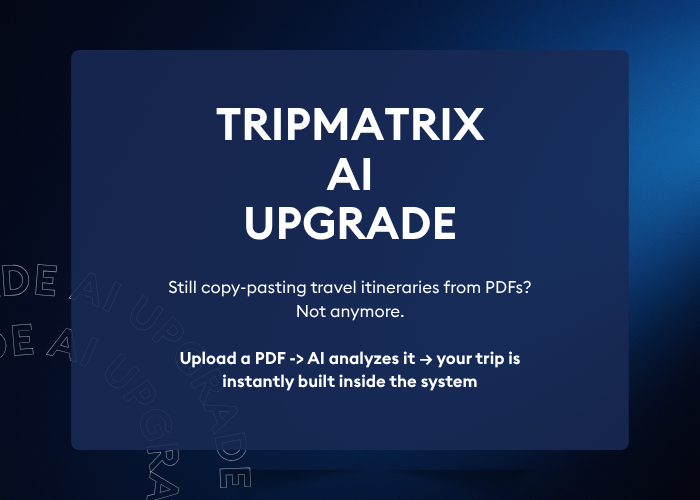
TripMatrix AI Import uses an advanced language AI model to automatically analyze PDFs, recognize destinations, hotels, experiences/activities, and transfers, and turn them into a fully structured itinerary and planner within the system. This allows agents to maintain professional-quality offers, reduce manual work, and focus on what really matters; selling and creating unforgettable experiences.
The algorithm first checks whether it can identify a day-by-day structure. After that, it analyzes the document for destinations, accommodation and other relevant elements, including any alternatives. It can recognize and automatically map them into the itinerary and planner.
No manual retyping, no duplicate work, no wasted time.
Why AI Matters in Modern Travel Software
The travel industry works with large amounts of unstructured data. Offers arrive as PDFs, itineraries are written in descriptive text, hotels and activities are embedded in paragraphs, and alternatives or optional services are often hidden within long documents.
The challenge is simple: A PDF is static. Operational systems require structured data.
Artificial intelligence bridges that gap. Instead of manually converting text into structured elements, AI analyzes the content, understands the trip logic, and automatically maps it into the system.
Key benefits of using AI in travel software:
- Faster package creation and customization
- Fewer operational errors
- Standardized content
- Better reuse of the Inventory database
- Scalable operations without increasing administrative workload
AI doesn’t replace travel experts, it removes repetitive manual work so they can focus on selling and delivering exceptional experiences.
How AI Import (PDF) Works
The process is simple and intuitive:
-
Create a Package
The first step is creating a Package. In the Create package window select “Create from PDF with AI” option and choose between Itinerary only or Itinerary + planner items.
-
Upload the PDF
Upload the PDF document (e.g., an itinerary with day-by-day descriptions, included services, hotel alternatives, etc.).
-
AI Analysis via TripMatrix AI Assist
TripMatrix AI Assist analyzes the document and identifies:
- Day-by-day structure
- Accommodation details
- Experience / activity descriptions
- Transfers and transport
- Included and excluded services
- Alternatives and optional experiences
Automatic Structuring
The system then automatically:
- Populates the Details sections
- Creates the day-by-day itinerary
- Builds the Planner (if previously selected)
The result: your PDF becomes a fully operational trip inside TripMatrix, ready for refinement, pricing, or sending to the client.
What Gets Automatically Created and Populated
1. Detailed Content
Every professional offer starts with a clear and structured description. However, manually transferring this content from a PDF often requires cleaning, formatting and separating sections – a time-consuming task.
AI Import automatically identifies and structures key textual blocks.
From the document, AI recognizes and fills:
- Trip description
- Included / Excluded sections
- Other clearly defined content blocks
This ensures consistent, standardized, and professionally formatted content, without manual formatting.
2. Day-by-Day Itinerary (Daily Editor)
The itinerary is the core of every travel offer. Yet manually creating days, copying descriptions, and organizing activities often takes the most time.
AI Import automatically:
- Detects day divisions
- Creates Day 1, Day 2, etc.
- Populates titles and activity descriptions
- Preserves the logical flow of the journey
Narrative PDF text becomes a structured, editable itinerary inside the system.
Agents can still refine or personalize it, but the foundation is already built.
3. Planner Items
One of the strongest operational advantages of AI Import is visible in the Planner tab. While a PDF typically contains descriptive content, the level of structure depends on the agent’s needs and preferences. If a day-by-day descriptive itinerary is sufficient, it can remain in that form.
In the Planner tab, the system automatically adds:
- Destinations and locations – Recognizes cities and geographical points and assigns them to the correct days
- Accommodation – Adds hotels with check-in/check-out details where available; content (descriptions and images) is sourced from the accommodation inventory if available, otherwise via the GIATA service
- Activities and experiences – Converts included tours and excursions into structured items
- Transfers and transport – Identifies and structures transportation details – rent-a-car, vehicles, transports
The result is a fully built itinerary, including map view, meaning the trip becomes immediately visual, structured, and operationally ready.
4. Alternatives and Options
Travel offers sometimes include hotel alternatives or optional experiences buried within the text.
AI adds items to the planner with details it finds in the document, for example:
- Accommodation (check-in/out, names)
- Experiences / Activities
This keeps offers flexible while maintaining clarity and organization.
Alternatives and/or options are currently added alongside other items where they belong, allowing the travel professional to keep or remove them as needed.
The Key Benefits of This Upgrade
AI Import delivers clear operational advantages:
- Faster trip and offer creation
- Reduced manual copy/paste work
- Fewer operational errors
- Automatically structured itinerary and planner
- Smarter use of the Inventory database
- Scalable growth without increasing administrative burden
Conclusion
In travel, speed and accuracy often determine whether you win the sale.
AI Import (PDF) in TripMatrix enables you to transform existing PDF offers into structured, operationally ready, and professionally formatted trips in just a few clicks.
Less administration.
More selling.
Smarter workflows.
This is the future of travel software – and it’s already built into TripMatrix.
Interested to see how
TripMatrix can supercharge your
travel business?
Request a Demo
Published on: May 8, 2026