The Digital Friction in DMC Operations: Why Your “Layered” System is Holding You Back

In the world of Destination Management Companies (DMCs), the dream is to provide seamless, personalized experiences. However, the reality behind the office doors is often a chaotic “Frankenstein’s Monster” of disconnected software.
DMCs often focus on optimizing pricing, negotiating better supplier contracts, or improving margins. While these are important, they are not the root cause of operational inefficiency.
The real challenge in modern DMC operations is far more fundamental: fragmented, disconnected software systems that do not communicate with each other.
From CRM tools to spreadsheets, accounting platforms, and communication apps, most DMCs operate in a patchwork of disconnected systems. This creates manual work, duplicated data, operational blind spots, and significant inefficiencies across the entire travel lifecycle. In practice, this means your team spends more time moving data between systems than actually designing and delivering exceptional travel experiences.
Why DMC Operations Are Broken: The Hidden Cost of Fragmentation
The average DMC relies on 6–8 different tools to manage a single booking. While each system may be powerful on its own, the lack of integration between them creates significant digital friction across the entire workflow.
This fragmentation results in constant manual data entry across multiple platforms, increasing the risk of inconsistent or duplicated information. It also slows down response times for both leads and clients, as data must be repeatedly transferred and verified between systems. Over time, this disconnected structure leads to operational errors in pricing, itineraries, and invoicing, while also limiting scalability and contributing to team burnout. Ultimately, the issue goes beyond simple inefficiency, it creates a structural barrier to sustainable growth within DMC operations.
The 6 Layers of DMC “Chaos”
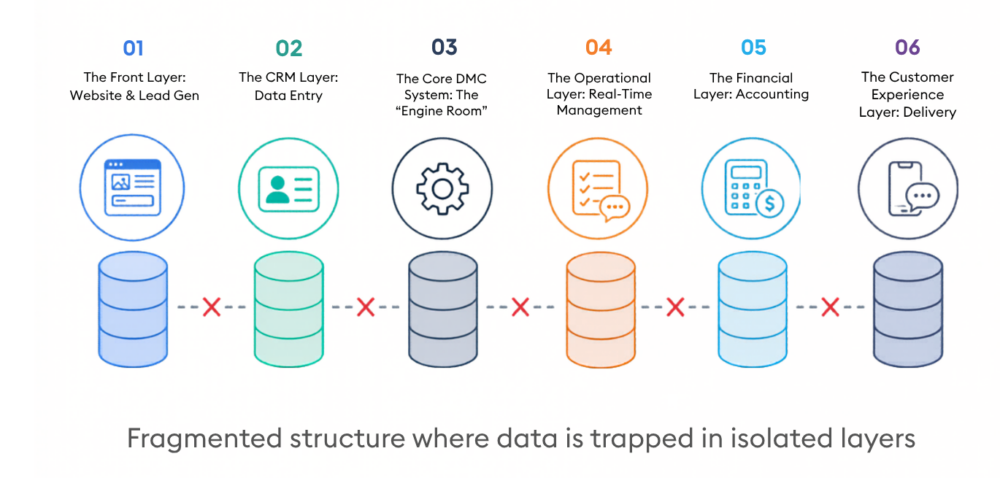
Most DMCs today operate in silos. You likely recognize this fragmented structure where data is trapped in isolated layers:
1. The Front Layer: Website & Lead Gen
The Tools: WordPress, HubSpot, or custom-built landing pages.
The Problem: A lead comes in via a web form. It sits in an email inbox or a CMS. It is “dead data” until an agent manually picks it up and types the details into another system. There is no direct bridge between the “I’m interested” and the “Here is your quote.”
2. The CRM Layer: Data Entry
The Tools: Salesforce or HubSpot CRM.
The Problem: You store client preferences and contact info here. However, this layer is often completely blind to the actual travel products. The CRM doesn’t know which hotels are available, what the current margins are, or if the client has already booked a similar trip in your core system.
3. The Core DMC System: The “Engine Room”
The Tools: Specialized legacy programs or, more commonly, massive, complex Excel sheets.
The Problem: This is where you handle itineraries, pricing, and supplier lists. These legacy systems are notorious for having zero integrations with modern marketing or financial tools. They are “walled gardens” that require manual, painstaking updates for every price change or new supplier contract.
4. The Operational Layer: Real-Time Management
The Tools: Trello, Asana, or Slack.
The Problem: To track daily changes, dietary requirements, or flight delays, teams use project management tools. This creates a third version of the truth. When a change is made in Trello, it is almost never automatically synced with the final itinerary or the final invoice, leading to operational “blind spots.”
5. The Financial Layer: Accounting
The Tools: QuickBooks or Xero (used as standalone apps).
The Problem: When it’s time to bill, the accounting team has to manually transcribe data from the itinerary or the booking system into the invoice. One simple typo here doesn’t just mean a correction, it means lost revenue, incorrect tax filings, or a major legal headache.
6. The Customer Experience Layer: Delivery
The Tools: Travefy, WhatsApp, and fragmented PDF emails.
The Problem: The traveler experience is fractured. They receive a beautiful itinerary link in one app, are asked to pay via a bank link in another, and chat with the agent on a third. For a high-end DMC, this disjointed process feels unprofessional and cumbersome.
The Core Issue: DMC Systems Do Not Share Data
The fundamental problem across all six layers is not the tools themselves, it is the lack of system-wide integration.
Every platform holds a partial version of the truth, but none of them operate as a single ecosystem.
- CRM holds the client
- DMC system holds the itinerary
- Accounting holds the money
- Communication tools hold the context
A Better Approach: Unified DMC Software Systems
Modern DMC operations require a shift away from fragmented tools toward a unified, connected software ecosystem. Instead of relying on multiple disconnected platforms, a single integrated system enables automated lead capture with CRM sync, centralized itinerary and supplier management, real-time operational updates, integrated financial processing, and seamless traveler communication.
This eliminates manual duplication and ensures all teams work from the same live, accurate data across the entire booking lifecycle.
The TripMatrix Vision: One Ecosystem, Zero Redundancy
What if these layers weren’t separate islands, but a single, fluid ecosystem? TripMatrix was designed to eliminate the “manual bridge” between these layers, creating a unified flow of data from the first click to the final voucher. 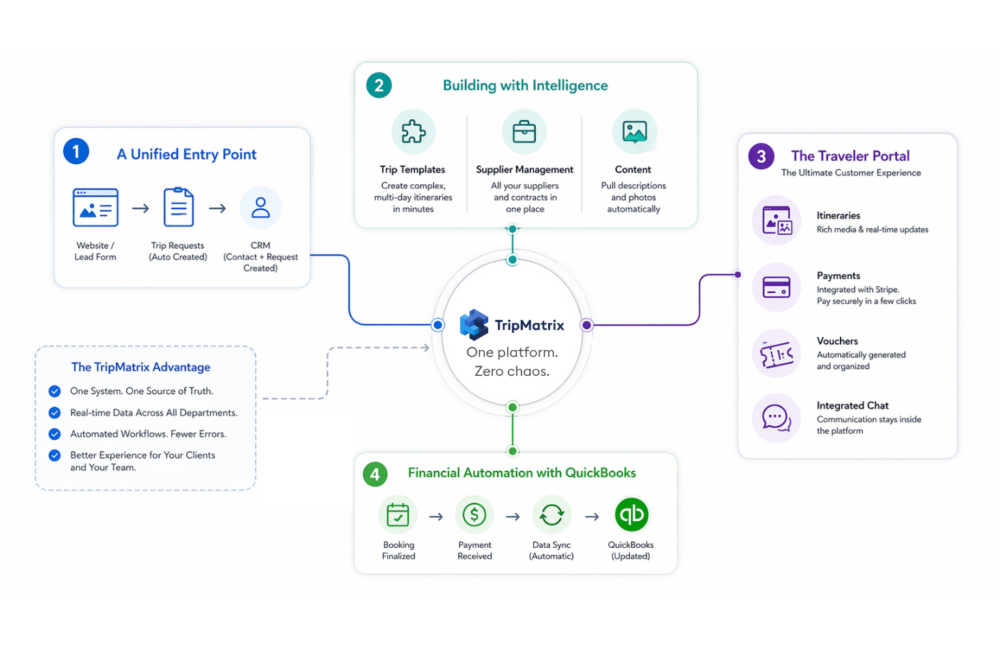
A Unified Entry Point
With TripMatrix, your website is directly hooked into the Trip Requests module. When a client submits an inquiry, the system automatically populates the CRM, creating a contact and a request simultaneously. No more manual entry. Your sales team can start working on a lead the second it arrives.
Building with Intelligence
The Core DMC System in TripMatrix is powered by an integrated Inventory hub.
- Packages: Create complex, multi-day itineraries in minutes using pre-saved templates.
- Supplier Management: All your suppliers and contracts are in one place.
- Content: Pull high-quality descriptions and photos automatically, keeping your offers visually stunning without the manual upload.
The Traveler Portal: The Ultimate Customer Experience
Instead of sending PDFs, you provide your client with a Traveler Portal. This is where the Experience and Financial layers merge:
- Itineraries: Clients view their trip with rich media and real-time updates.
- Payments: Integrated with Stripe, the portal allows clients to pay securely in a few clicks.
- Vouchers: Once payment is confirmed, the system generates and organizes all vouchers in the portal automatically.
- Integrated Chat: Communication stays inside the platform, ensuring the agent always has the trip context at hand.
Financial Automation with QuickBooks
The “manual transcription” nightmare ends here. TripMatrix integrates directly with QuickBooks. When a booking is finalized or a payment is made, the data is pushed to your accounting software automatically. This ensures your margins are tracked accurately and your books are always “audit-ready.”
The True Cost of “Too Many Tools”
When you count them up, the average DMC is juggling 6 to 8 different, unconnected platforms just to manage one single booking.
Every time a team member switches from HubSpot to Excel, or from Trello to QuickBooks, they aren’t just switching tabs, they are risking a mistake. This fragmented way of working leads to a massive drain on productivity:
- Lost Time: Sifting through multiple apps to find one client update or verify a price.
- Reduced Precision: Data that is typed and re-typed across 8 different platforms eventually loses its integrity.
- Agent Burnout: Your experts should be designing travel, not acting as human bridges for manual data entry.
TripMatrix replaces this chaos with a streamlined, professional, and automated platform. It’s time to stop managing software and start managing destinations.
Ready to see the difference a unified system makes?
Interested to see how
TripMatrix can supercharge your
travel business?
Request a Demo
Published on: June 5, 2026