Will AI Replace Travel Agents? The Truth About the Future of Travel Planning

The Question That’s Reshaping An Entire Industry
Searching “will AI replace travel agents?” returns a mix of extreme opinions. Some predict full replacement, while others insist humans will always be essential. The reality is more balanced and sits somewhere between those two views.
Short answer: no, AI will not replace travel agents in any meaningful near-term timeframe. But it will change what being a travel agent means, more fundamentally than the internet did in the 1990s, and faster.
The long answer is what you’re about to read.
Where AI In Travel Actually Stands Today
The tourism industry isn’t waiting for AI to arrive. It’s already here, already embedded in the infrastructure most travellers never see. Dynamic pricing on flights, personalized hotel recommendations, fraud detection on your booking confirmation, the chatbot that answered your cancellation query at midnight, all of it is AI, running quietly behind the scenes.
What AI Is Actually Good At (And Where It Falls Apart)
Any honest conversation about AI replacing travel agents has to get specific. Generative AI, the kind powering ChatGPT, Google Gemini, and specialised travel platforms like TripMatrix, is genuinely excellent at certain tasks and genuinely poor at others.
What AI does exceptionally well
- Speed-processing large datasets. Comparing hundreds of flight and hotel combinations in seconds, without fatigue, without missing options buried on page eight of the results.
- Always-on availability. No business hours, no bank holidays, no sick days. A traveller in a different time zone gets an instant response regardless.
- Generating starter itineraries. Given a destination, a budget, a travel style, and a date range, AI can produce a credible first draft of a trip plan in moments.
- Automating the administrative layer. Booking confirmations, price-change alerts, reminder sequences, repetitive tasks that eat agent time.
- Multilingual communication. Instant, accurate support across dozens of languages without translation delays or errors.
- Synthesising reviews at scale. AI can read thousands of guest reviews, extract consistent themes, and flag patterns a human researcher would miss in a week.
Where AI still falls short
- Real-time crisis management. When a flight is cancelled at 11pm, a connection is missed, and a family is stranded in an unfamiliar city, an agent who knows the client – their preferences, their temperament, their loyalty tier with the airline – is worth more than any chatbot.
- Negotiation. Experienced agents have built relationships with hotels, airlines, and tour operators over years. They can secure room upgrades, waive cancellation fees, and arrange credits that an algorithm simply cannot access.
- Emotional intelligence. A honeymoon. A trip planned around a parent’s final wish. Travel needs arising from disability or serious illness. These situations require empathy and contextual understanding that current AI does not have at a deep level.
- Genuine local knowledge. An agent who has personally been to the destination, who knows which beach gets crowded by noon, which restaurant is worth the detour off the tourist strip, which neighbourhood is better than it looks on the map, brings something no training dataset can replicate.
- Luxury and complex travel. The more expensive and intricate the trip, the more the human factor matters. A $50,000 safari itinerary or a corporate travel programme for 80 executives is not a task to delegate to an algorithm.
What The Data Says
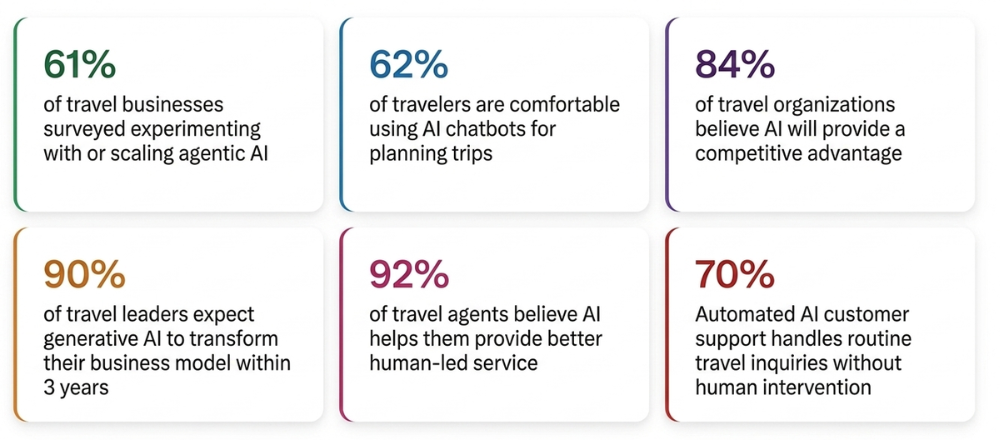
- 61% of travel businesses surveyed experimenting with or scaling agentic AI
- 35% of hotels and travel companies currently use AI for business operations
- AI helps travel managers detect 95% of corporate policy violations automatically
- 62% of travelers are comfortable using AI chatbots for planning trips
- Automated AI customer support handles 70% of routine travel inquiries without human intervention
- 84% of travel organizations believe AI will provide a competitive advantage
- 90% of travel leaders expect generative AI to transform their business model within 3 years
- 92% of travel agents believe AI helps them provide better human-led service
A Pattern History Has Seen Before
The tourism industry survived one existential technology scare already. When Booking.com launched in 1996 and Expedia followed shortly after, the consensus prediction was that travel agents were finished. Direct booking would make them irrelevant. Why pay a middleman when you could book yourself?
What happened instead was differentiation. Agents who specialised (adventure travel, destination weddings, corporate travel management, luxury itineraries) found that clients increasingly valued their expertise precisely because the internet had made standard bookings a commodity. The agents who competed on standard bookings lost. The agents who competed on expertise, relationships, and service quality thrived.
The AI moment is the same pattern, accelerated. Generative AI will commoditise the transactional elements of travel planning even further. The agents who survive and grow will be those who clearly offer what AI cannot: judgment, relationships, emotional intelligence, and deep specialist knowledge.
The question is not whether the industry will change. It will. The question is which agents will change with it.
The Real Dividing Line: Routine Tasks Vs. Complex Experiences
The core of the whole debate comes down to a single distinction: routine tasks versus complex experiences.
There are tasks where AI performs exceptionally well, especially those that are routine, repetitive, and data-driven, where consistency and speed matter most. At the same time, there are tasks that still require a human approach, where context, emotional intelligence, judgment, and nuance are essential to achieving a meaningful outcome.
How The Value Splits
|
Task |
AI |
Human agent |
|---|---|---|
|
Comparing flight and hotel prices |
✅ Excellent |
⚠️ Slow |
|
Generating starter itinerary drafts |
✅ Fast |
⚠️ Time-consuming |
|
Deep personalisation to client preferences |
⚠️ Partial |
✅ Excellent |
|
Crisis management (cancelled flight, illness) |
❌ Limited |
✅ Essential |
|
Negotiating with partners and suppliers |
❌ None |
✅ Irreplaceable |
|
Emotional support for sensitive travel |
❌ Insufficient |
✅ Indispensable |
|
Luxury and complex itineraries |
⚠️ Support role |
✅ Leading role |
|
24/7 availability |
✅ Always |
❌ Limited |
|
Multilingual communication |
✅ Instant |
⚠️ Depends on agent |
The Luxury Travel Case: Where Human Expertise Becomes Non-Negotiable
The luxury segment is worth examining separately, because it makes the AI paradox most visible.
Affluent travellers consistently rate trust, discretion, and personal connection as their top priorities. A high-net-worth client planning a private safari in Kenya, a family villa in Tuscany for a milestone birthday, or a bespoke cultural journey through Japan is not looking for algorithmic efficiency. Instead, they are looking for an expert who knows them.
The most successful model emerging in this segment is what’s being called AI-assisted bespoke travel planning, combining traditional luxury consulting with data-driven tools that enhance personalisation, efficiency, and flexibility, while keeping the human touch that defines premium service.
AI handles data analysis and routine tasks with efficiency, freeing up human concierges to focus on complex, high-touch interactions that require emotional intelligence and nuanced understanding. AI is an invisible infrastructure. The agent is still the face, the voice, and the relationship.
While digital transformation is crucial for most market segments, the luxury travel sector continues to prioritise human interaction for a more personalised touch. That’s not a temporary lag in technology adoption. It’s a deliberate choice by travellers who can afford any option they want, and who keep choosing human expertise.
Why Superintelligence Is Not Around The Corner
It’s worth being clear-eyed about the actual state of AI technology. At their core, generative AI models are sophisticated systems that predict the most likely next piece of text based on patterns in enormous training datasets. And training them can cost millions.
There’s also a less-discussed constraint: researchers are approaching the limits of high-quality text data available for training. The internet has been largely consumed. Companies are turning to unconventional methods; AI transcribing video content, simulations generating synthetic data, but these remain early-stage workarounds, not solutions.
Full automation of professional roles like travel agents requires something far beyond current AI architecture. The more realistic trajectory is a long period of AI augmentation, where agents with AI tools significantly outperform both agents without AI and AI operating without agents. That’s the window the industry is in right now.
What This Means For Travel Agencies In Practice
An agency that wants to stay relevant over the next several years needs to move on a few fronts simultaneously:
- Invest in AI tools that automate the routine and free up capacity for higher-value work, not to cut headcount, but to raise the quality of what each agent can offer.
- Redefine the agent’s role from transactional intermediary to travel advisor, experience curator, and crisis manager.
- Build niche expertise that AI cannot replicate through generalism. An agent who specialises in, say, solo female travel, accessible travel for wheelchair users, or culinary immersion itineraries in Southeast Asia has something no algorithm can offer.
- Use AI for deeper client understanding – personalisation built on real data leads to loyalty that standard service cannot generate.
- Own the crisis moments – when things go wrong, that is when human presence matters most, and when clients remember who had their back.
Agencies that reject AI because they “don’t need it” are repeating the mistake of the agencies that rejected the internet in the late 1990s. Agencies that think AI will do everything for them are making the opposite error. The only defensible position is in the middle: a human empowered by AI.
The Bigger Picture: Travel Has Always Been About People
Somewhere in all the market projections and automation statistics, it’s easy to lose sight of what the travel industry is actually for.
People travel because they want to feel something. A sense of adventure, of beauty, of connection to history or culture or family. They travel to mark life’s milestones – the honeymoon, the anniversary, the graduation trip, the bucket-list destination before it’s too late. Traditional travel agents remain essential for high-touch, complex, and high-stakes travel experiences where personalisation and trust are critical.
AI is genuinely transforming how those experiences get planned and booked. It is making the process faster, cheaper, and more accurate for the routine elements. But the desire to be understood, to tell someone what kind of traveller you are, what you need, what you’re afraid of, what you’ve always dreamed of, and to have someone who actually listens turn that into a real trip: that remains irreducibly human.
The answer to “will AI replace travel agents?” is the same answer that applied to every other technology that was going to replace something valuable. Technology changes the landscape. The people who understand the landscape, and use the new tools better than anyone else, are the ones who win.
TripMatrix: Where Smart Technology Meets Genuine Travel Expertise
TripMatrix is built on exactly this understanding. The platform combines AI-powered import with the irreplaceable knowledge of experienced travel professionals, so travellers get the speed and intelligence of modern technology without losing the human expertise that makes the difference between a good trip and an exceptional one.
Interested to see how
TripMatrix can supercharge your
travel business?
Request a Demo
Published on: June 21, 2026